
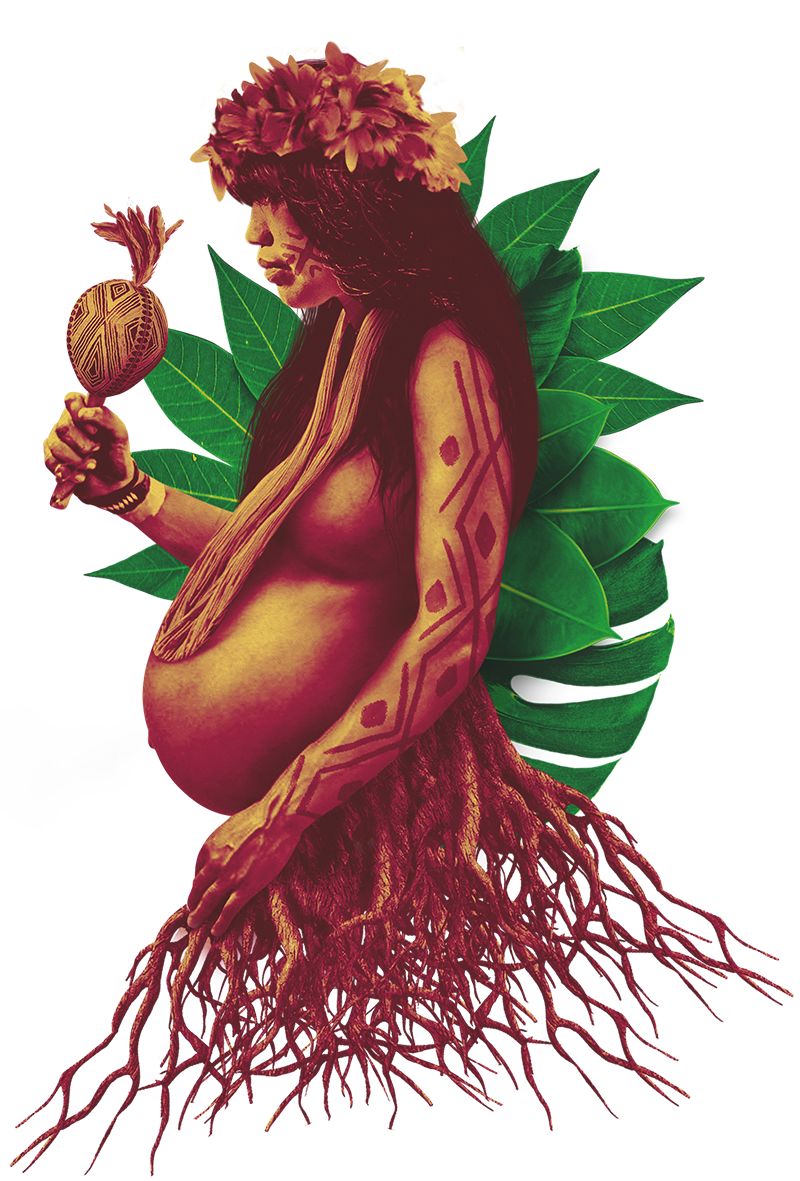
Our March
Ritual from our bodies territories in movement
The Indigenous Women’s Marches are seeds planted in the fertile ground of ancestry, blossoming from our collective strength — from Indigenous women who, from the ground of our villages, move the world through our songs, our bodies, and our dreams. Since 2019, we have mobilized this space of denunciation, gathering, and ancestral strength, connecting biomes and territories in defense of life and Indigenous knowledge.
Held every two years, the marches carry a meaning that goes beyond mobilization. For us, they are political and spiritual rituals, woven through encounters among the body-territories of Indigenous women, who affirm themselves in movement, creating alliances and pointing pathways toward the healing of the Earth.
It was during the First Indigenous Women’s March, in 2019, that history was made. With the presence of 2,500 Indigenous women from more than 130 Peoples, this ancestral uprising met, in Brasília, the strength of rural women workers participating in the Marcha das Margaridas, which brought together around 100,000 women. The ground of the federal capital was crossed by voices of struggle and resistance, weaving alliances between the forest, countryside, and Cerrado. It was there that the national articulation that would become ANMIGA began to take root.
The following year, in 2020, faced with the advance of the pandemic and forced isolation, Indigenous women did not remain silent. The cry echoed across digital territories: online mobilizations, live conversations, and listening spaces were organized with leaders from all biomes. The collective pain of the pandemic, which deeply affected Indigenous Peoples, also became a space for political reflection and the strengthening of ancestral listening.
And it was in March 2021, the month of women and a milestone of resistance, that our National Articulation of Indigenous Women Warriors of Ancestry (ANMIGA) was born. As we stated in our manifesto, “the original women of the Earth, who were present in the first marches, now connect in a more organic way to continue the struggle, for the Bem Viver of our peoples and for the healing of the planet.”
Since then, the marches have continued as a constant pulse of our struggles: spaces for political formation and collective construction. To march is to continue weaving living networks, where every step is taken to plant seeds. A living call. An invitation to strengthen the struggle for Mother Earth, who is the mother of all struggles.
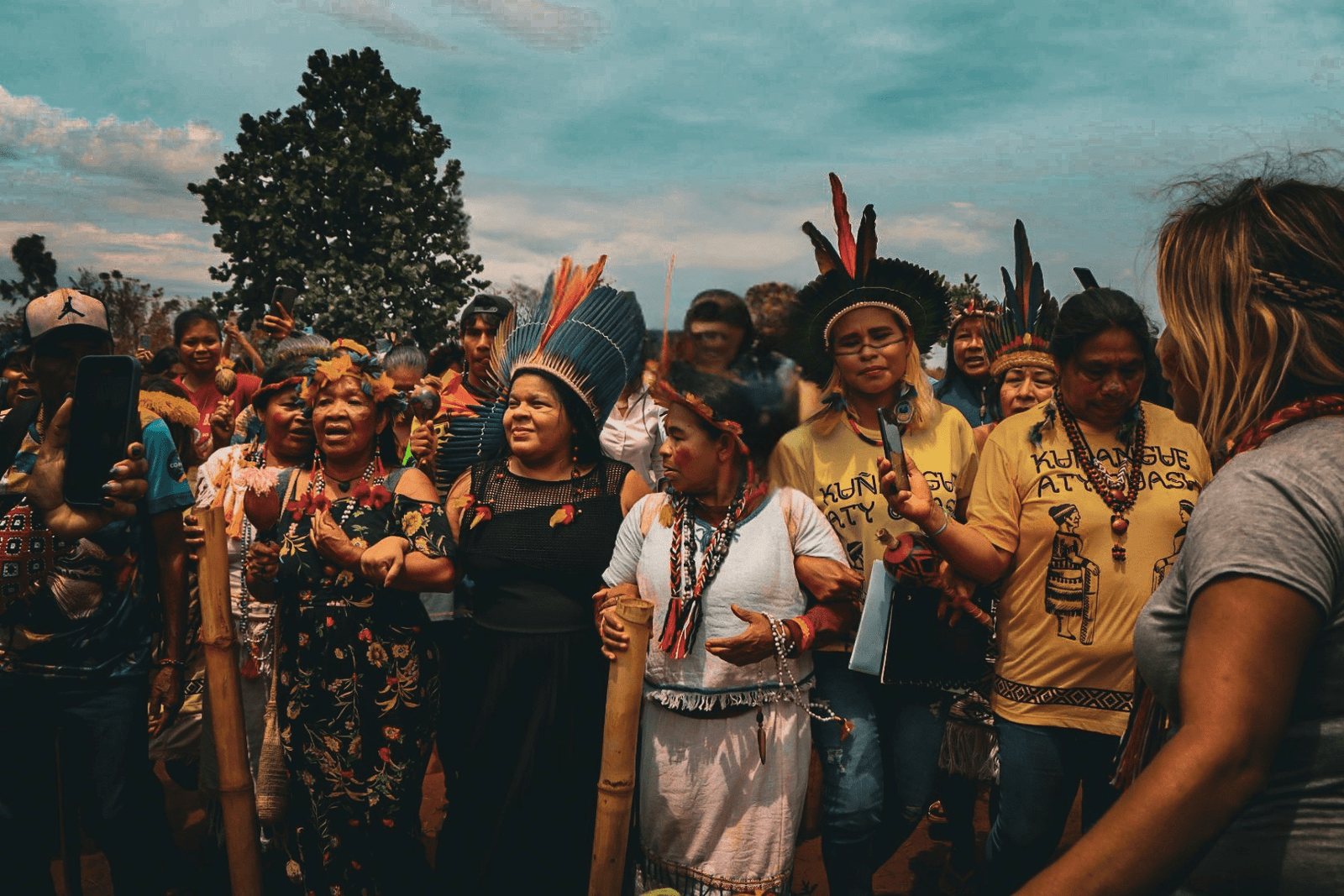
Territory: our body, our spirit
The Indigenous Women’s March is a territory of political affirmation, where our ancestral voices move from the present toward the future, guided by the wisdom of those who came before us. Marching is a collective act of resistance and existence. It is an action that strengthens the representation of Indigenous women in all decision-making spaces, from the ground of the village to institutional spaces of power.
By bringing together thousands of women from all biomes, the March builds bridges between territories, promotes intergenerational listening, and nurtures leaders committed to Bem Viver. It is within this gathering that political advocacy strategies are shaped, such as the creation of the Cocar Caucus to strengthen Indigenous candidacies and the protagonism of Indigenous women in national and international conferences.
The March also denounces and confronts the multiple forms of violence that cross the body-territories of Indigenous women: racism, patriarchy, institutional violence, gender-based violence, and environmental violence. By placing these issues at the center of public debate, the March calls for public policies that welcome, protect, and respect the knowledge, cultures, and autonomy of Indigenous women.
In the collective journey of the March, every step is both resistance and proposition. It is a way of affirming that there is no full democracy without the living, autonomous, and powerful presence of Indigenous women.
Marching also heals!
Timeline of our Marchs
Body Territory in motion: Our Mobilization for the Healing of the Earth
2019
1st Indigenous Women's March Women
Brasilia, 9 to 13, August
Territory: our body, our spirit
The Indigenous Women’s March began to be dreamed of in 2015. Years of dialogue, listening, and collective construction followed, until, in 2019, during the Free Land Camp (Acampamento Terra Livre – ATL), this dream took shape and found its direction. It was there, on the ground of the ATL, that the first national Indigenous Women’s March was organized, scheduled for the International Day of the World’s Indigenous Peoples, on August 9 of that same year.
Excerpt from the manifesto “We Have Resisted for 519 Years and We Will Continue Resisting,” from the 15th Free Land Camp (Acampamento Terra Livre – ATL), held from April 24 to 26, 2019.
With the presence of more than 2,500 Indigenous women from 130 Peoples, the March occupied Brasília with songs, prayers, and bodies in movement. In that historic moment, it joined the March of the Daisies, forming an ancestral uprising of more than 100,000 women of the Earth, the forest, and the waters, weaving alliances among struggles, knowledge systems, and ways of existing that have resisted for centuries.
Advocacy
- We built the first national mobilization of Indigenous women from all Brazilian biomes, laying the foundation for the beginning of ANMIGA’s construction.
- We helped expand the fronts of resistance against the Bolsonaro Government’s project of destruction.
- We delivered our political manifesto to the Supreme Federal Court (STF), into the hands of Justice Cármen Lúcia.
- We strengthened the alliance between Indigenous women and other women’s movements from rural and urban areas.
Our Struggles and Proposals
We echoed our Final Document of the Indigenous Women’s March: “Territory: Our Body, Our Spirit “
- Demarcation is
healing Guarantee the demarcation of Indigenous territories. Violating our Mother Earth is violating our bodies and our lives. - Whole territories, free from mercury and fences
Ensure the full right to ownership and protection of our territories. Demand that the State end mining, leasing, agribusiness greed, and illegal invasions. Profit cannot be placed above life. - Health with spirit, body, and ancestry
Defend differentiated healthcare for Indigenous Peoples. Maintain and strengthen the Indigenous Health Care Subsystem (SESAI), respecting our traditional practices, our midwives, healers, and spiritual leaders. Health is holistic; it is also spiritual. We reject the privatization, municipalization, or state-level transfer of healthcare services. - Not one right less: against the Temporal Framework thesis
Demand that the Supreme Federal Court (STF) recognize the original rights to Indigenous lands and definitively reject the Temporal Framework thesis. Indigenous rights are not a concession: they are our origin. - Justice means recognizing difference
Demand that the Judiciary ensure access to justice while respecting our diversity, languages, cultures, and our own forms of social organization. Let the Constitution and the international treaties signed by Brazil be fulfilled. - Representation with presence and decision-making power
Promote the active presence of Indigenous women in political spaces — villages, parliaments, universities, ministries. It is not enough to recognize our narratives; it is necessary to recognize those who tell them. - Racism and sexism out of decision-making spaces
Confront the violence and discrimination faced by Indigenous women who experience structural racism and patriarchy in spaces of power. - Sacred food, free from poison
Defend the right of all Peoples to healthy food, free from pesticides, and rooted in the wisdom of Mother Earth. - Education with our languages, histories, and schools
Demand differentiated and quality education that values Indigenous languages, recognizes our own curricula, and ensures adequate infrastructure. Guarantee the implementation of the proposals from the National Conference on Indigenous School Education and the strengthening of ethnoeducational territories. - Public policies built through participation and listening
Demand Indigenous policies that recognize our diversity and are built through listening to our organizations. Plan, implement, and monitor policies through dialogue and Indigenous protagonism. - Combat violence through specific policies
Reaffirm the urgency of specific legislation to address violence against Indigenous women while respecting the cultural realities of each People. - Empowerment means education and information
Guarantee full access for Indigenous women to formal education and the recognition of traditional knowledge. Strengthen information, training, and awareness-building for the achievement of our rights. - Indigenous movement with women and youth
Strengthen the Indigenous movement by integrating gender and generational perspectives. Let the voices of young women, elders, and leaders intertwine. - No to racism! Enough of institutional violence!
Firmly confront racist and anti-Indigenous discourses and practices, including those carried out by public officials. Demand reparation, accountability, and protection for our leaders.
And finally, we reaffirm:
We will continue strengthening alliances with women around the world — from the countryside, the cities, the forests, and the waters — who also fight for the dignity of their bodies and ways of life. Our struggle is part of the struggle for life on Earth.
Read the full manifesto: https://apiboficial.org/2019/08/15/documento-final-marcha-das-mulheres-indigenas-territorio-nosso-corpo-nosso-espirito/
2020
National Mobilization for the Healing of the Earth
7 and 8, August | Online Mobilization
The Sacredness of Existence and the Healing of the Earth
When the COVID-19 pandemic threatened our lives and deepened the violence in our territories, we did not remain silent. We occupied another ground: the digital space. We marked the screens as territories of resistance and carried out the largest online mobilization of Indigenous women ever recorded, under the theme “The Sacredness of Existence and the Healing of Mother Earth.”
How could we remain silent in the face of genocide, preventable deaths, and institutional abandonment? How could we be silent while Mother Earth cries alongside us? We connected across all corners, through our songs, and reaffirmed: we are the healing of the Earth.
Our work during the pandemic was collective, connected with the Articulation of Indigenous Peoples of Brazil (APIB) and its seven regional organizations: the Coordination of Indigenous Organizations of the Brazilian Amazon (COIAB); the Articulation of Indigenous Peoples and Organizations of the Northeast, Minas Gerais, and Espírito Santo (APOINME); the Articulation of Indigenous Peoples of the South (ARPINSUL); the Articulation of Indigenous Peoples of the Southeast (ARPINSUDESTE); the Great Assembly of the Guarani People (ATY GUASU); the Terena Council; and the Guarani Yvyrupa Commission (CGY). Through the organized Indigenous movement, we coordinated sanitary barriers, denunciations, humanitarian support, campaigns, and protection protocols, confronting the State’s neglect through our own strategies of collective care.
The virtual mobilization became a space of both report and creation. We reclaimed matriarchal values and memories, built support networks, and developed collective strategies to confront the pandemic at territorial, regional, and national levels. We worked on sanitary barriers, organized community protection plans, and coordinated donations and humanitarian actions. We did all of this amid pain, but also through the strength of the ancestry that guides us.
What we began in 2019 as proposals for struggle became, in 2020, concrete action, a collective urgency, and a spiritual force. We reaffirmed our commitments and expanded the movement by bringing together the knowledge of young women, elders, mothers, and leaders, because our path is intergenerational and our time is ancestral.
2021
2nd Indigenous Women's March
Brasilia, 7 to 11, September
Reforestminds for Earth's healing
The year 2021 called us to confront new challenges. Amid the COVID-19 pandemic and under the politics of death imposed by the Bolsonaro government, it was us, Indigenous Peoples, who first organized nationally to occupy Brasília. We were already present on screens and digital networks, with intense online mobilizations since March. With the birth of ANMIGA, in Indigenous Womens March, we advocated for the vaccination of our Peoples and continued walking alongside APIB in the organization of the second virtual edition of the FreeLand Camp, which strengthened our political articulation during Indigenous April. But we knew: occupying screens was not enough. With the return of the Temporal Framework thesis to the agenda of the National Congress and Federal Supreme Court, driven by the interests of agribusiness, we understood that it was time to occupy the streets as well.
Our presence was resistance. During the pandemic, the threat was not only the COVID-19 virus; it was the State attempting to erase our bodies and territories. Even so, we rose. For life, for the land, and for the memory of our Peoples, we stepped into the struggle.
Through the strength of Indigenous mobilization, we were able to guarantee our right to priority vaccination. It was through the campaign #VacinaParente, from Apib and action ADPF 709, through the campaign also led by APIB before the Supreme Federal Court (STF), we compelled the government to protect our lives. And it was with this strength that we continued on to Brasília, with our health protocols, our songs, and the ancestral courage that moves through our body-territories.
In June, it was held the Free Land Camp, in response of the advance of PL 490, which intended to tear apart the Constitution and legalize the theft of our territories. In August, Indigenous Peoples once again occupied Brasília during the mobilization, Fighting for Life, in defense of our original right to our territories and against the violence of the Temporal Framework thesis. It was within this collective pulse that we, Indigenous women, arrived with our seeds, maracás, and ancestral forces.
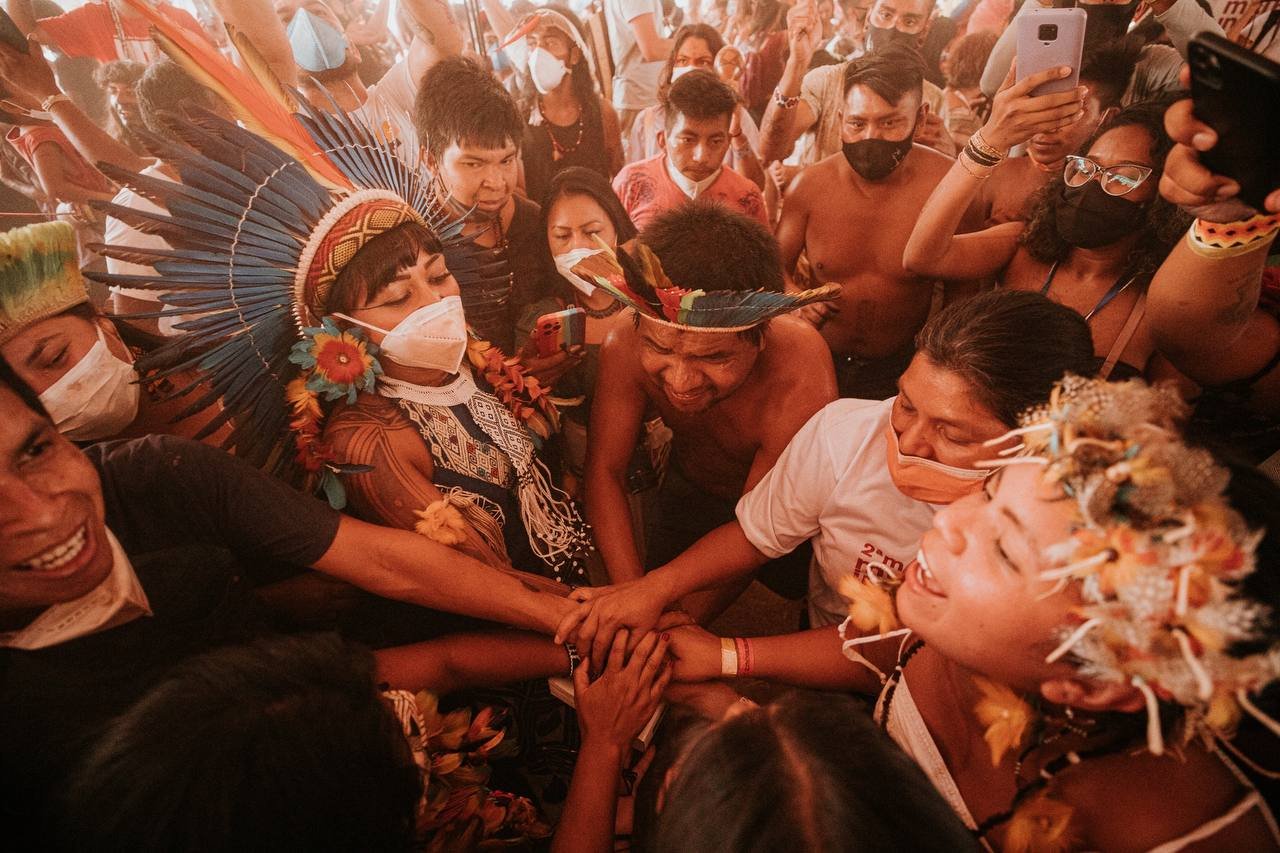
WE MADE HISTORY! The 2nd Indigenous Women’s March brought together more than 7,000 women from 185 Peoples, representing all Brazilian biomes, who marched from September 7 to 11. While the country was being shaken by hate speech and extremist threats, our mobilization in Brasília was surrounded by far-right truck drivers who threatened to invade the camp. Still, we stayed strong: “for the life of women, for us, for children and the elders”, we continue marching, reforesting minds for the healing of the Earth and to stop the advance of the Temporal Framework thesis.
We did not publish a formal letter, but we left our mark in every step, in every song, and in every path we walked. We reaffirmed our commitment to continue fighting for life, for the territory, for climate justice, and for Living Well. It was at this moment that ANMIGA, born months earlier, consolidated itself as a living articulation of Indigenous women warriors of ancestry.
Instead of issuing a political statement, we let the call of Reforestminds, a breath of wisdom that reminds us that, in the face of destruction, we must sow dreams, affections, soma, solidarity, ancestry, collectivity, and history. A living manifesto that sprouts from our body-territories and teaches us: in times of devastation, we must reforest minds to heal the Earth.
2023
Pre-March
Brasilia, 30 January to 01 February
Ancestral Voices from the 6 Biomes
The year 2023 began as both a harvest and a seed. In January, we held the Pre-March of Indigenous Women, under the theme “Ancestry Voices from the 6 Biomes”, convening more than 200 indigenous women for a strategic meeting of articulation and listening. This moment marked the beginning of the journey towards the III March of Indigenous Women, but it was also a space for balance and political reorientation of the actions we carried out in the previous cycle.
Between May and November 2022, we had traveled the country with the Caravana das Originárias, a journey of strengthening, welcoming and mobilizing in the territories. There were 22 meetings in 17 states, directly involving 952 indigenous women and reaching more than 5 thousand indirectly. The Caravan showed us that the roots of our struggle were alive in all biomes, and that it was time to flourish again in Brasilia.
At the same time, we consolidated the institutional strength of our presence with the construction of the Cocar Caucus (Bancada do Cocar), a political platform created by us, indigenous women from Anmiga, to occupy spaces of power. In 2022, the highest participation of indigenous women candidates in the history of Brazil’s elections was recorded, with a growth of 193% since 2014.
It was with this strengthened foundation that we started 2023. The Pre-March allowed us to look clearly at the paths of representativeness: we debated our presence in the ministries, in the National Congress, and the direct impact on the newly created Ministry of Indigenous Peoples.
2023
3rd March
Brasilia, September 11 to 13
Women Biomes in Defense of Biodiversity through Ancestral Roots
In September 2023, with the maracas in hand and the firm songs of ancestry, we returned to Brasília to hold the 3rd March of Indigenous Women, reaffirming that the struggle for Mother Earth is the mother of all struggles. Under the theme “Women Biomes in Defense of Biodiversity through Ancestral Roots”, we brought together indigenous women from all biomes in Brazil, strengthening our bonds of struggle and healing.
The march was born from the collective call of Anmiga, who organized themselves to echo, once again, their voices in defense of life. Our goal was to connect and reconnect the ancestral strength of the seeds that we are, bringing to the center of the political debate the performance of indigenous women who, with their bodies-territories in movement, face violence against the land and point out paths for regeneration.
The 2023 march was rooted in environmental and climate urgencies, at a time when our biomes continue to be the target of attacks, deforestation, and destruction projects. It was in this scenario that we placed ourselves as guardians of biodiversity, reaffirming that there is no social justice without demarcation and listening to the voices from the earth.
During the days of the march, ancestry and incidence were together. We held plenary sessions, dialogue circles, listening between generations and strategies to strengthen our presence in the decisions that impact our lives. The III March also boosted preparations for the 1st National Conference of Indigenous Women, reinforcing the importance of creating permanent spaces for participation and political proposal.
Even without the publication of a formal political note, we left our direction marked in every song, ritual and speech. We march for free territories, for whole bodies, for the healing of the earth and for the continuity of a world where ancestry is present and future.
2025
4th March and 1st Conference of Indigenous Women
Brasilia, August 02 to 08, 2025
Our body is territory! We are guardians of the planet for the healing of the earth
In 2025, our steps will echo again in Brasilia, for the fourth edition of the largest mobilization of indigenous women in Brazil, to affirm that, if the earth is a mother, we are the continuity of existence. IV March of Indigenous Women was part of a larger cycle of mobilization that unified two other great moments of our national articulation: the ANMIGA Assembly and the 1st National Conference of Indigenous Women.
We gathered our strength between August 4th and 8th, 2025. We were more than 5 thousand indigenous women from the six Brazilian biomes and also from other countries walking together, taking to the center of the country the voices that spring from the villages, from the retakes, from the peripheries and from the territories in resistance.
We began our March by echoing our maracas to strengthen the opening ceremony, organized with our songs and rituals, which opened the political discussion with the strength of spirituality. The mobilization occupied Brasília with our collective body, as a territory in movement.
During the March, seeds were sown that will continue to germinate throughout 2025 in the various articulations guided by us at ANMIGA. In the March’s program, we presented our Map of Indigenous Women’s Organizations, bringing together 241 organizations spread across the country, showing that our strength lies in the diversity of peoples and mobilizations to meet the multiple demands that involve indigenous life and especially us women.
We also point out paths for our articulation for the year 2026, which is crossed by the elections. Our Cocar Caucus (Bancada do Cocar) as strengthened with the goal of electing 10 women in the National Congress to represent our demands and those of the entire indigenous movement.
We promoted our “Ancestral Jury”, an important space for listening to complaints from the various territories against indigenous women. Our intention is to provoke action on these complaints. We need answers and to hold our rights and those of our peoples accountable. We also affirm that the defense of climate justice must be seen as an inseparable part of social, territorial and gender justice.
THE STRUGGLE FOR MOTHER EARTH IS THE MOTHER OF ALL STRUGGLES
We use the streets of Brasilia as fertile territory to sow our proposals and echo our denunciations. With our courage and firmness, we strengthen the confrontations against the attempts of the National Congress to legalize crimes such as the Time Frame Legal Thesis , (Marco Temporal), the Devastation Bill, projects that aggravate invasions of our territories and false green solutions. We will not rest while our lives and those of our peoples are threatened.
Connected with our March, we strengthened the mobilization of the ‘1st National Conference of Indigenous Women’ that deepened the debates held during the days of our program. The Conference was born from a national listening process carried out in territories of the seven biomes in conjunction with the Ministry of Indigenous Peoples. More than 7.000 people participated in this historic moment, including delegates, the general public, guests, observers, government representatives and the press. 125 proposals were prepared. In plenary, 50 were prioritized as strategic to guide public policies aimed at indigenous women.
The strategic axes that organized the proposals dialogued with the urgencies of the territories. They are:
Law and Territorial Management: demarcation and homologation of lands, revocation of the time frame, strengthening of PNGATI (National Policy for the Territorial and Environmental Management of Indigenous Lands), funds and management instruments with female protagonism.
Climate Emergency: access to clean water, women’s indigenous brigades, climate emergency fund, renewable energy, food sovereignty and biodiversity protection.
Public Policies and Gender Violence: creation of Indigenous Women’s Houses (CAMIs), reference centers, national plan against institutional racism, prevention of violence.
Health: strengthening SESAI, indigenous health houses and midwives, combating obstetric violence, valuing traditional medicine and midwives.
Education and Ancestral Knowledge: specific quotas and scholarships, strengthening of indigenous languages and curriculum, differential competitions for indigenous teachers, creation of the Special Secretariat for Indigenous Education.
OUR MESSAGES
At the end of our entire process of national mobilization organized around the ‘IV March of Indigenous Women’, we launched messages to the world synthesized in three political letters that consolidated our collective commitment.
The Charter of the Bodies-Territories reported environmental degradation and reaffirmed Buen Vivir (Well-Living) as a principle of life and governance. The Conference Charter systematized the 50 priority proposals as the basis for a National Policy Plan for indigenous women. And we also organized our international message with the ‘Charter of Global Voices for the Healing of the Earth’, which carries the agendas of indigenous women from 15 countries, who, among other points, claim permanent seats in multilateral spaces for global political decision-making on climate and human rights.
The IV March, connected to the 1st Conference, strengthened our vision as ANMIGA on indigenous governance. It expanded our articulations in the territories, in the country and in the world. It reaffirmed the strength of our diversity in struggle and consolidated a strategic path for our next steps, among them we highlight the expansion of our political advocacy towards COP 30 and with the construction of the Caravan of the Indigenous Women of the Earth 2026, which we intend to take ANMIGA’s presence to the territories of all Brazilian biomes.


