

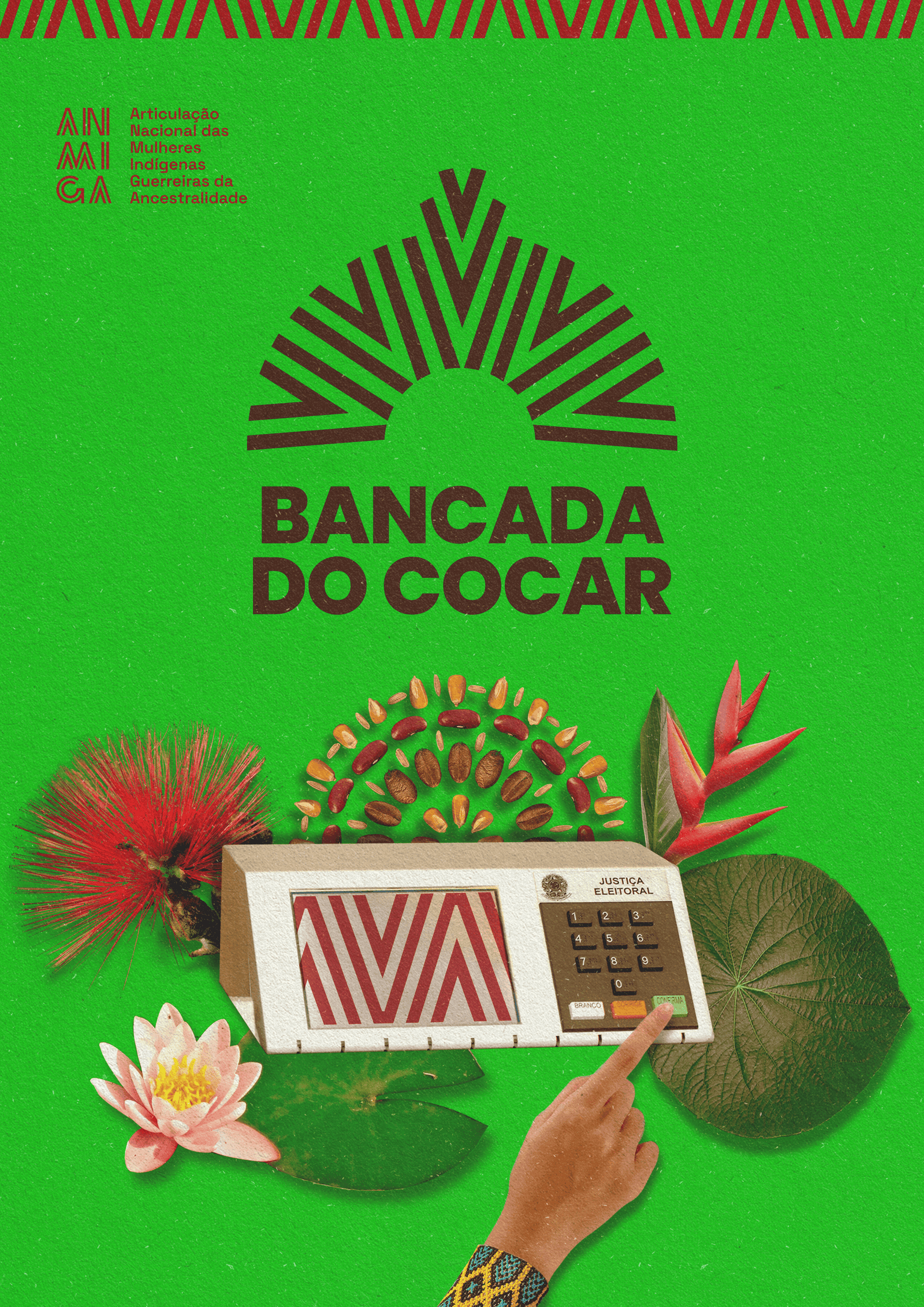
We, at Anmiga, echoed the sound of our maracás to announce the birth of the Cocar Caucus (Bancada do Cocar) in 2021.
We plant our feet firmly on the ground, we raise our heads with our eyes turned to the horizon, aware that it is not enough to occupy the spaces of power, we need to transform these structures.
These spaces were not created for us, and that is why we decided to organize, to demarcate politics with our bodies territories.
Our Caucus did not start from nothing
Before us, many women came, our midwives, who taught us that politics is also done carefully, firmly, with words that sprout from the ground.
The Cocar Caucus represents another step in the long march of indigenous women in Brazil.
It was born from the pulse of our marches, our assemblies, the Caravan of the Indigenous Peoples of the Earth that traveled through the six biomes listening to the voices and cries of each territory.
It flourished as an answer: to occupy the spaces where they have always decided for us, but never with our participation.
We are not asking for space, we are paving the way!
Our voices, which echo from the ground of the territories, also need to vibrate in parliaments, city halls, councils, ministries, the judiciary, the presidency of the country.
We built the Cocar Caucus so that decisions about the future of Brazil pass through the hands, words and knowledge of the first daughters of this land. So that no country project is made without the face and soul of our people.
We continue to march, strengthening candidates, creating networks, building a Brazil from its roots and that respects the guardians of ancestry.
Before the Brazil of the Crown there is the Brazil of COCAR (headdress)
The Cocar Caucus (Bancada do Cocar) was not born in a cabinet, it was born on the march!
Every step on the avenues of Brasilia, every corner echoed in the six biomes, every meeting in a circle was part of the birth of our Bench. We, at Anmiga, planted this seed in the fertile land of our ancestors.
The history of the Cocar Caucus (Bancada do Cocar) begins long before its name was said. It begins with the courage of our ancestors, those who planted healing and fight for justice.
It comes from the struggles waged within the territories, from the grassroots assemblies, from the health councils, from the community meetings. It comes from the leaders who, for generations, defended their villages and biomes without ever being seen as part of “power”.
It was in this spirit that, in 2021, in the heat of our second March, we built the Cocar Caucus (Bancada do Cocar)
The following year, our proposal was strengthened with our walks through various territories in the Caravan of the Originaries of the Earth. A network that goes beyond electoral strategies and connects the spiritual as a collective orientation to make indigenous women decide the future of Brazil.
In 2022, the Cocar Caucus (Bancada do Cocar) presented itself to the country at the polls.
Candidacies were launched everywhere.
The number of indigenous women candidates grew 193% compared to 2014
Indigenous women who launched themselves into party politics presented candidacies in 26 of the 27 Brazilian states and the Federal District
It was a rooted movement, with voices that sprouted from the forest, the cerrado, the urban villages, the peripheries.
And we made history.
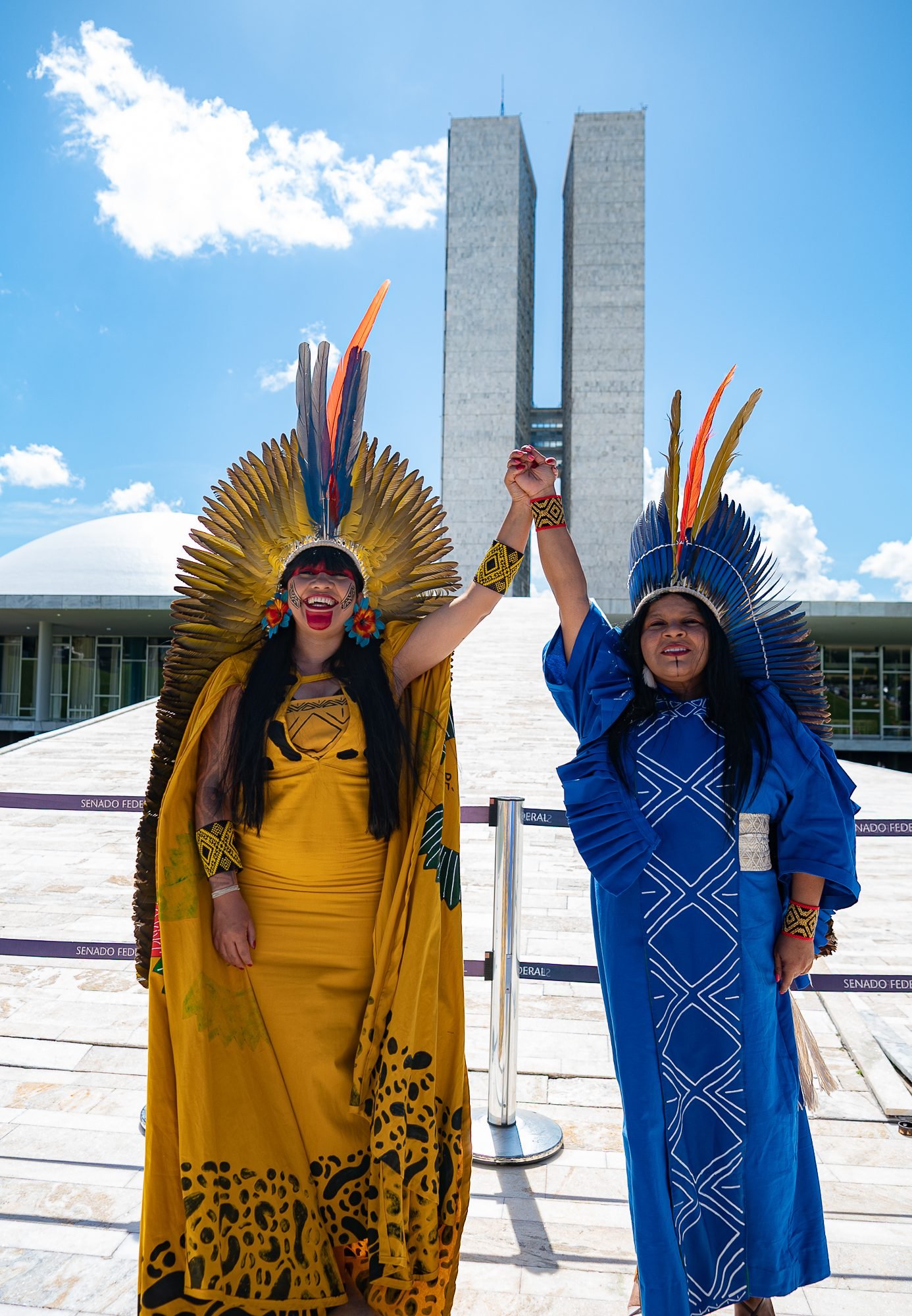
We occupied the National Congress with a headdress and the voices of the territories on our throats and strengthened the struggle of the indigenous movement to remove Bolsonaro’s genocidal government from power.
In 2024, the presence of women in the election intensified
Of the more than 2,500 indigenous people who ran in the municipal elections, 887 were women
The Cocar Caucus (Bancada do Cocar)grew, flourished and spread like a root that sustains the whole.
Fighting Bases | from the village floor to the ballot boxes of the country
1969
First recorded indigenous mandate
Manoel dos Santos, Mr. Coco, from the Karipuna people, is elected councilor in Oiapoque (AP).
1976
Resistance at the polls
Chief Ângelo Kretã wins an electoral battle and is elected councilor in Mangueirinha (PR).
1982
First voice in the National Congress
Mário Juruna becomes the first indigenous federal deputy in the history of Brazil.
1990
The strength of the indigenous woman
Iracy Cassiano becomes the first indigenous woman elected mayor in Brazil, in the municipality of Baía da Traição.
2014
Official registration of indigenous candidacies begins
The TSE includes the “race/color” field in the registration of candidacies, making visible what has always been present.
Between 1976 and 2012, it is estimated that 448 indigenous mandates were won in this period, according to a survey by researcher Luís Roberto de Paula.
2017
For an increasingly Indigenous Parliament
Apib launches the first manifesto of the indigenous movement to strengthen indigenous representation in spaces of power.
2018
Indigenous Women demarcate national politics
Joenia Wapichana is elected the first indigenous woman federal deputy.
Sonia Guajajara ran for vice president on the ticket of Guilherme Boulos, the first indigenous woman on a presidential ticket.
2020
Indigenous Campaign to Raise Politics
Apib launches its first campaign to encourage indigenous candidacies.
2,212 indigenous people apply, 234 indigenous people elected, 10 mayors, 11 deputy mayors, 213 councilors, 31 indigenous women elected from this total.
2021
Birth of Anmiga and Cocar Caucus (Bancada do Cocar)
During the II March of Indigenous Women and the Caravan of the Indigenous Peoples of the Earth, the Cocar Caucus (Bancada do Cocar) was officially born.
2022
Cocar Caucus (Bancada do Cocar) occupies Congress
85 candidacies from indigenous women, an increase of 193% since 2014. Sonia Guajajara elected federal deputy for São Paulo, Juliana Cardoso elected federal deputy for SP, Célia Xakriabá elected federal deputy for MG, Raquel Tremembé is running for president as vice president for the PSTU
2024
oots that spread at the grassroots
2,506 indigenous candidates in municipal elections, 887 candidacies of indigenous women.• 36 indigenous councilors elected, 1 mayor and 4 deputy mayors.
For the first time, indigenous candidacies access party funds, TV and radio time, and a specific field for peoples in the TSE registry.
Indigenous Policy
Since 2014, when the Superior Electoral Court (TSE) began to register information on indigenous peoples in candidacies, information has emerged that was previously invisible to our struggles. These data are a reflection of the growing presence of indigenous women in the dispute over institutional politics.
The advance of indigenous women proportionally exceeds the growth of indigenous male candidacies, consolidating the strength of this movement.
General Elections
State and Federal Deputies – Senators – Presidency
| YEAR | CANDIDATES | GROWTH | RESULTS |
|---|---|---|---|
| 2014 | 29 | - | Beginning of the formal registration with data of peoples in municipal elections. |
| 2018 | 85 | +193% | Joenia Wapichana, elected first indigenous federal deputy woman. Sonia Guajajara ran for vice president. |
| 2022 | 441 | +418% | Three indigenous deputies are elected: Sonia Guajajara, Célia Xakriabá and Juliana Cardoso. Raquel Tremembé is running for the presidency as vice-president. |
The jump between 2018 and 2022 is the largest in the series, directly reflecting the strengthening of the political organization of indigenous women and the national movement.
Municipal Elections
Councilwomen – Mayors – Vice Mayors
| YEAR | CANDIDATES | GROWTH | RESULTS |
|---|---|---|---|
| 2016 | 192 | - | 19 elected councilors |
| 2020 | 265 | +38% | 31 indigenous women elected: 1 mayor, 2 deputy mayors and 28 councilors |
| 2024 | 887 | +234% | 41 indigenous women elected: 36 councilors, 1 mayor and 4 deputy mayors |
The jump between 2020 and 2024 represents the largest growth in the history of indigenous women in municipal elections. It is a direct reflection of the construction of the Cocar, Anmiga and the National Indigenous Campaign.
Confronting machismo and political violence
The path to this point has never been flat for us, indigenous women. If today we are a living presence at the ballot box and in parliaments, it is because we have broken not only the fences of colonialism, but also the fences of patriarchy that try, to this day, to keep our bodies and our voices away from decision-making spaces. Institutional politics carries in its structure a machismo that crosses not only the parties, but also community relations and the electoral system itself. And this is evident when we look at the numbers: while indigenous men have an average success rate of 13.5% at the polls, we, indigenous women, still face the harshness of being only 4.5% of those elected. The unequal dispute is not only at the ballot box, it begins with the difficulty of accessing resources, spaces of visibility, campaign time and party support.
Still, we continue to break through. Because if the structural machismo of politics tries to push us to the margins, the force that moves us comes from another source: from the womb of the earth, from our ancestors, from our corners, from our territories. Our path, of indigenous women, began to be officially registered only in 2014, when the TSE began to count our existence. Since then, we have doubled, tripled and continued to grow. And if the data still reveal a small representation, they also scream a greater truth: no country project will be fair if it does not carry the face, the word and the time of indigenous women.
Our mobilization at the elections
Indigenous women advanced proportionally more in the municipal elections between 2020 and 2024 (+234%) than in the general elections between 2018 and 2022 (+418%, on a larger base).
The strongest data from the general elections was in 2022, when for the first time three indigenous women occupied seats in the National Congress, while in the municipal elections the strongest milestone came in 2024, with a record of 887 candidacies and the election of 41 women.
Until 2014, we have no records of an indigenous woman elected. The historic turning point came in 2018, with Joenia Wapichana breaking the silence of centuries in Congress.
The growth occurs in all regions of Brazil, with a strong presence in the Legal Amazon, Northeast and Southeast.
The creation of the Ministry of Indigenous Peoples and also of state secretariats of indigenous peoples (as in Ceará, Amapá and Pará) also reflects this process of institutional occupation beyond the eletrocnic voting machines.
Collective organization, the Indigenous Women’s Marches, the Caravan of the Originaries and the creation of the Cocar Caucus (Bancada do Cocar) are central elements for this advance.
The data are not just numbers, they are marks of the presence, resistance and strength of indigenous women in Brazilian politics. They are body-territories breaking with colonial, patriarchal and racist structures that have historically kept us out of decisions.


